The short answer
Not necessarily—and the useful question is why.
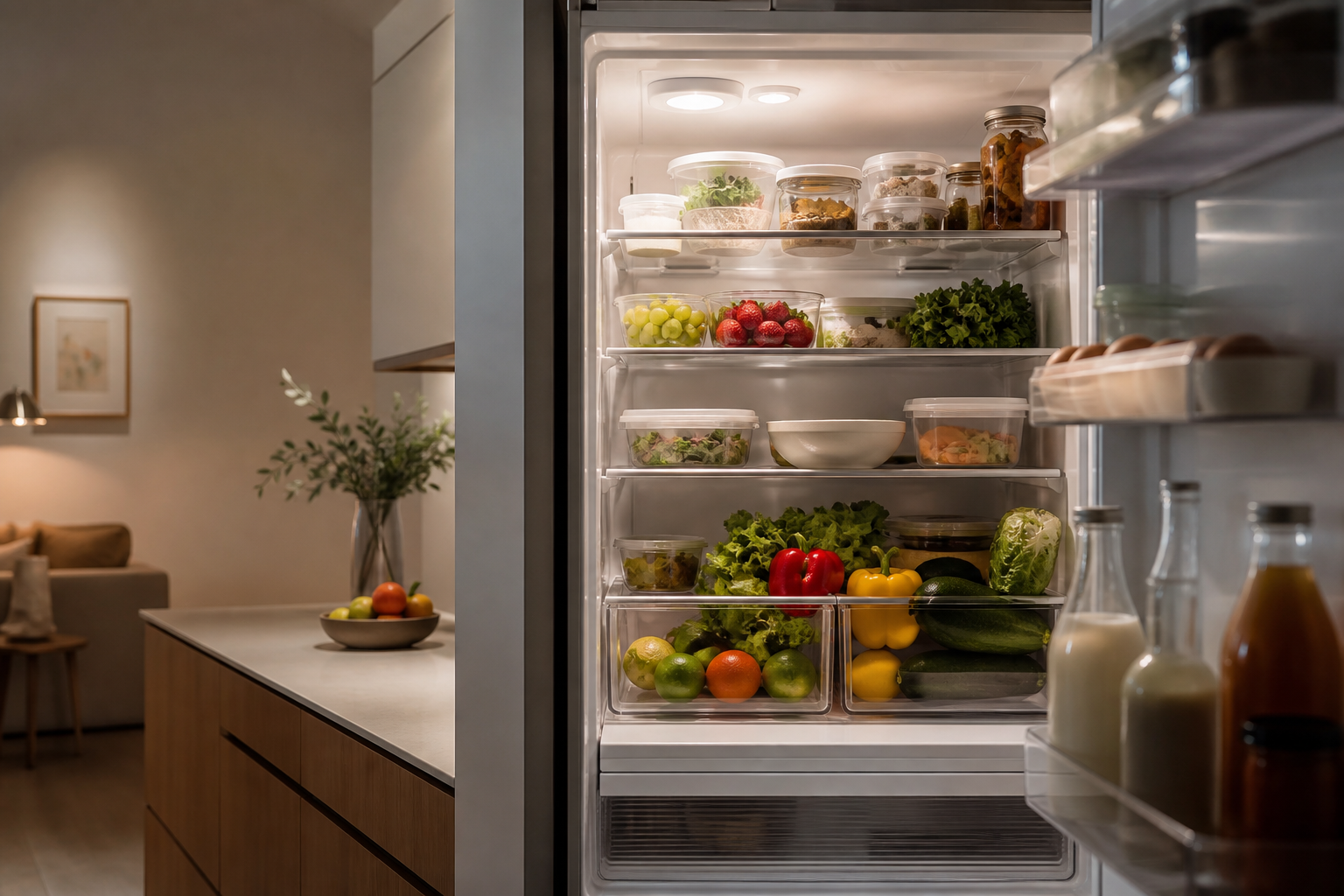
It is natural to assume that better cold storage means less food waste. A refrigerator gives food more time. Yet a household still has to remember what it bought, see what is already there, and decide what to make before its options narrow.
The study behind this article does not measure how full a refrigerator is. The title is a prompt for the everyday intuition many of us share. The research instead examines refrigerator usage and food waste in rural Chinese households—and estimates a counterintuitive behavioural rebound.
The paper in one glance
The finding is a chain of behaviour—not a verdict on refrigerators.
Cold storage changes what a household can keep and buy.
The authors identify stored food quantity as a key pathway.
In this sample, preservation did not guarantee timely use.
An original Frespace redraw of the paper's proposed pathway; it is not the paper's original figure.
What the researchers studied
A household system, not an appliance in isolation.
Household observations from the China Health and Nutrition Survey.
The study uses three survey waves, not a contemporary global sample.
It estimates what food-waste outcomes might look like with and without refrigerator use.
The headline finding
In this sample, refrigerator use did not automatically mean less waste.
estimated increase in food waste among refrigerator-using households
estimated increase in calorie loss in the same analysis
These are the authors' estimates for their study population, not a universal forecast for every refrigerator or household.
Illustrative index based on the paper's reported estimates—not a measurement of every household.
One plausible mechanism
More time can also make it easier to defer a decision.
The paper points to a familiar possibility: refrigeration can encourage larger purchases and longer storage. That may be helpful, but it can also move food out of view and postpone the moment when someone decides how to use it.
- 01Buy more
Storage feels less scarce.
- 02See less
Older items slip behind newer ones.
- 03Decide later
Meal choices get pushed forward.
- 04Lose options
Some food is no longer used in time.
What this paper does not say
Good research communication needs a boundary line.
- It does not show that every household refrigerator increases food waste.
- It does not measure fridge fullness, food placement, or every individual food decision.
- It does not make a claim about households outside its rural Chinese study context.
- It does not argue that refrigeration is bad; it shows that preservation and food management are different jobs.
A practical takeaway
Make the fridge easier to act on, not just easier to fill.
1 Before shopping, take a quick inventory of what is already there.
2 Put one older item or leftover where it will be seen first.
3 Decide on one use-up meal before adding more groceries.
Where Frespace fits
More context, before the next grocery run.
Frespace helps households build a shared view of their groceries and upcoming dates. It is a practical way to make food easier to notice; it is not a substitute for a household's own choices.